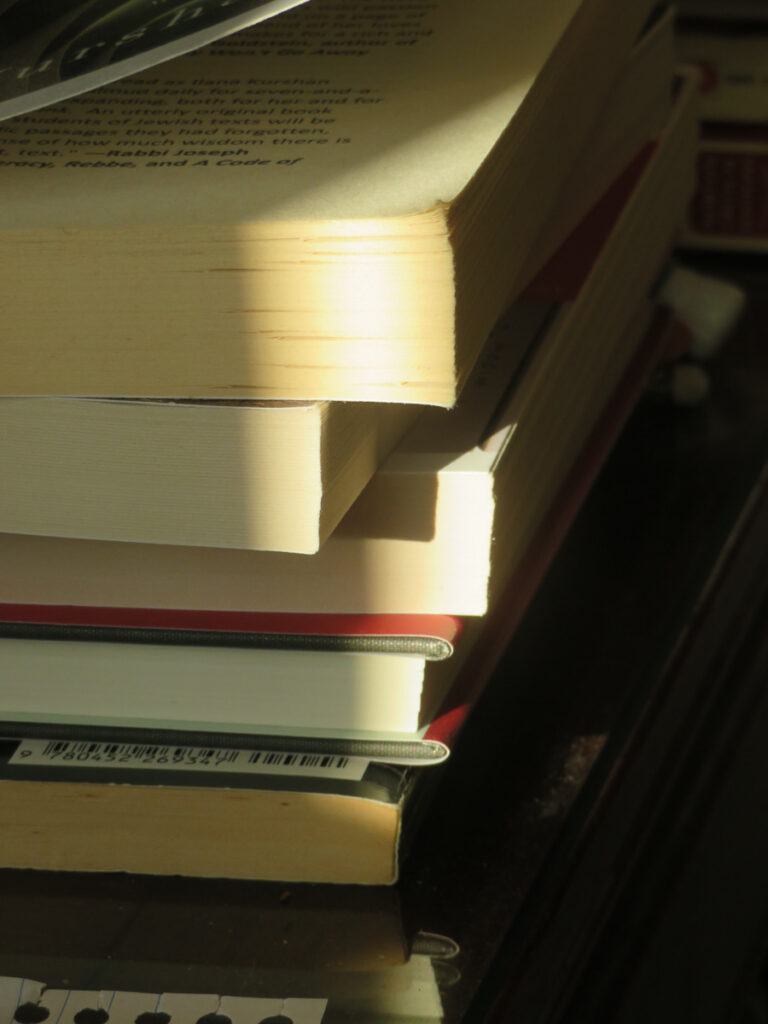
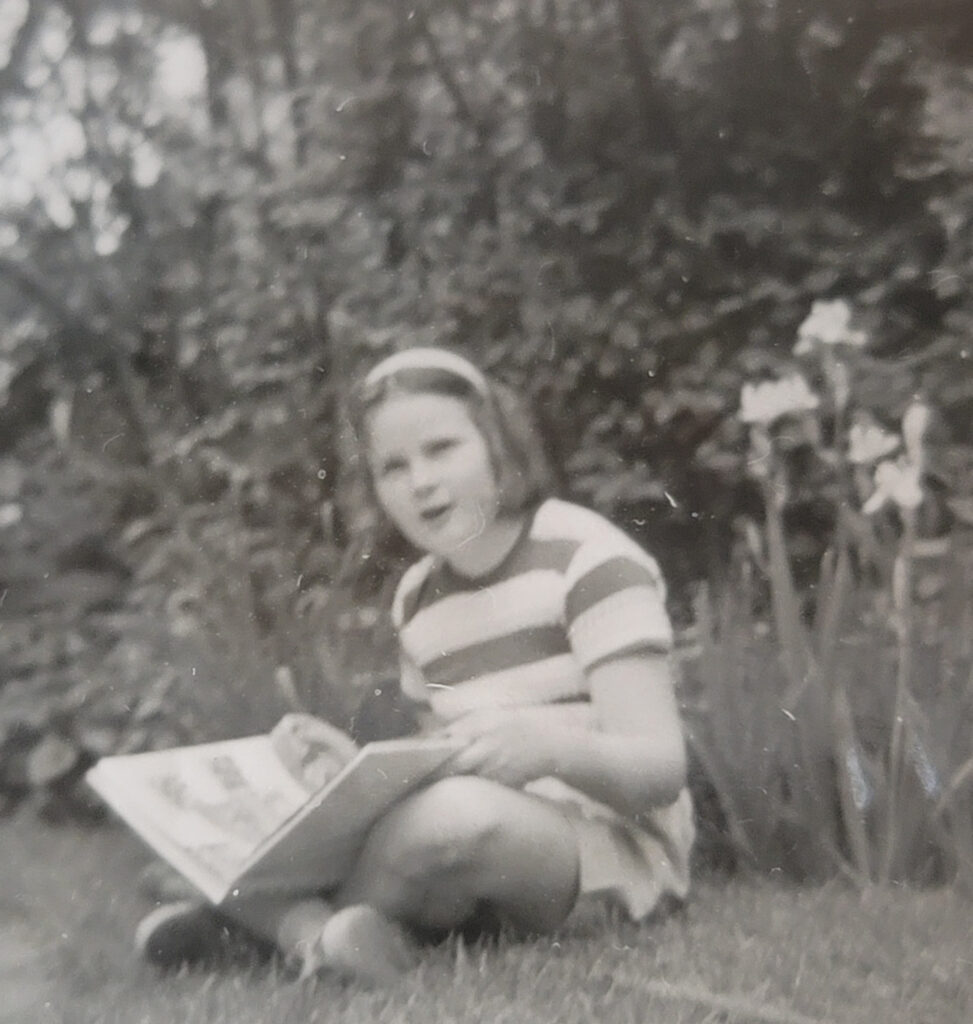
I recently celebrated my eightieth birthday, a milestone which brought with it far more than the usual streams of memory—one in particular. Setling down on the couch one evening for my beloved reading session, the thought popped up: I’ve been doing this for seven of those eight decades, and books are a major factor in my life, in all kinds of ways. I should be celebrating a kind of reading milestone.
Hmm, a reading birthday. Never heard of that. The closest thing is how many people remember a “the” when they realized, they knew, they could read. I’ve often heard it described as a blissful, over-the-waterfall sort of happening. Friends have even told me just what book or in what story their reading ability took hold.
But I can’t remember any such moment. I must been so ecstatic to just do it—to read freely, to swim in words and ideas, that my mind just charged off, “First star to the right, and then straight on ‘til morning,” in the words of Barrie’s Peter Pan.
Thinking back now, though, I recognize two, well, gardens of birth for my reading. And both branches of this reading seed were born in the house at on Central Street, Auburndale, a suburb of Boston.
A comfortable four-bedroom family home on a tree-lined street in the Boston suburb of Auburndale, 366 Central Street was built by my English grandfather Ernest Braithwaite in 1915. Sad to say, he died in my first year of life, so I never knew him. My grandmother (for whom I’m named) was Sallie Mallinson Braithwaite, who came to America from Yorkshire in 1904 to marry him. I don’t remember her having any English accent, though I may have been too young to recognize it; instead I remember the deferential tone of her speech, typical of her manner with everyone. She was a sweet and loving soul, and as children do, I simply accepted that this tender voice was “Grammie.”
Her sitting room, on the second floor, held something close to an English nursery atmosphere: a cozy nest, the corner of her couch next to the radiator. There Grammie read me poems from A.A. Milne’s When We Were Very Young, and Now We Are Six. Odd lines from them still float through my thoughts: “James, James, Morrison, Morrison, Wetherby George Dupree. . . , you must never go down to the end of the town if you don’t go down with me!” And a humbled king, in another poem, makes a piteous request, “I do like a little bit of butter for my bread.”
Of course we read Winnie the Pooh and our favorite part was when Piglet brings Eeyore the Donkey a balloon for his birthday; running late, Piglet falls on the balloon—pop!—and then says, “What’s that small piece of damp rag doing?” Grammie and I found this hilarious.
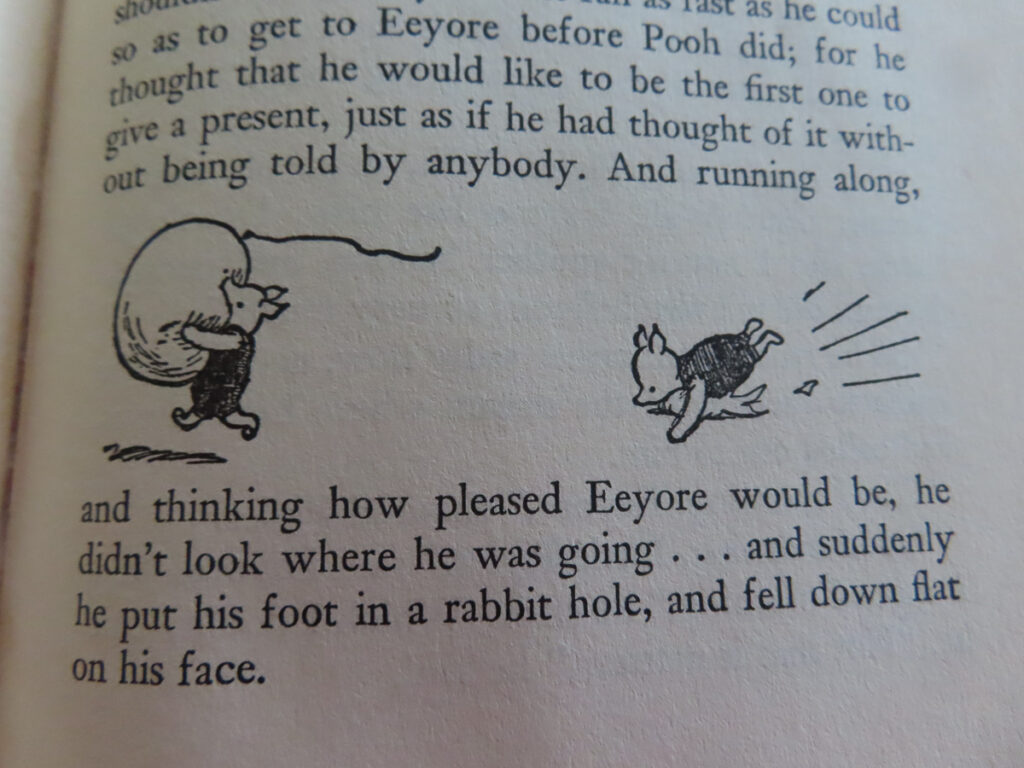
She also shared poems from Stevenson’s A Child’s Garden of Verses, including the lovely lines “The world is so full of a number of things/I’m sure we should all be as happy as kings.” Grammie loved Longfellow, too, especially The Children’s Hour whose beginning described our times together. “Between the dark and the daylight/When the night is beginning to lower/There comes a pause in the day’s occupations/That is known as the children’s hour.”
In addition, Grammie taught me prayers and the 23rd and 100th Psalms, also No. 91, the “battlefield” psalm. “A thousand may fall at your side, ten thousand beside thee, but it [the arrow that flies by day] shall not come nigh thee. . .” Along with this came a story about a British regiment in WWI, each of whose soldiers was given a copy of Psalm 91 to carry into battle, in his pocket—and every man survived. I wonder now how literally to take this story of Grammie’s but I believed it then and absorbed the “survival by faith” message it conveyed.
All these things she read, nonsense, story, or scripture, planted the idea that words mattered. And certain words, or certain combinations of words, sounded and could “speak.” Judging from Winnie the Pooh, reading was fun! Or it could make me curious, as when she read me Heidi, which introduced the strange idea that a grandparent might be gruff and off-putting instead of warmly intimate.
Grammie made little effort to teach me letters or reading. Following her voice as though she were the creator of the words and scenes, I began to pay attention to language and the music of words. I was being taught to want to read.
Probably then, it comes as no surprise that in first and second grade, I found learning to read extremely dull. I’ve blotted out just about every memory of the process, except how pallid I found Dick, Jane, and Spot. Also, their stupid little sister was named Sally and she didn’t know anything. I felt insulted to share a name with her.
Finally, however, I think sometime in third grade, the Reading Fairy descended and tapped me with her wand. Oh, now I can read! I could pick up a book and sight read, make sense of every line and follow the story. For myself, by myself.
I have never stopped.
I crave reading, I thirst for books.
Oddly the best illustration I can give is of a guy I once watched play the piano. His hands splaying out over large spans of keys, it was as though he were cramming notes into his mouth; no piece was too hard to launch in and try. It was as though he were attacking a great buffet, one platter after another.
So vital are books to me now, that I also put myself in the cartoon I saw recently of two angels in Heaven, white-robed and haloed, sitting on a cloud. Though I don’t know that I’ll ever get there, I’m right with the one who says, “Still, I can’t help wishing I’d brought along a good book.”
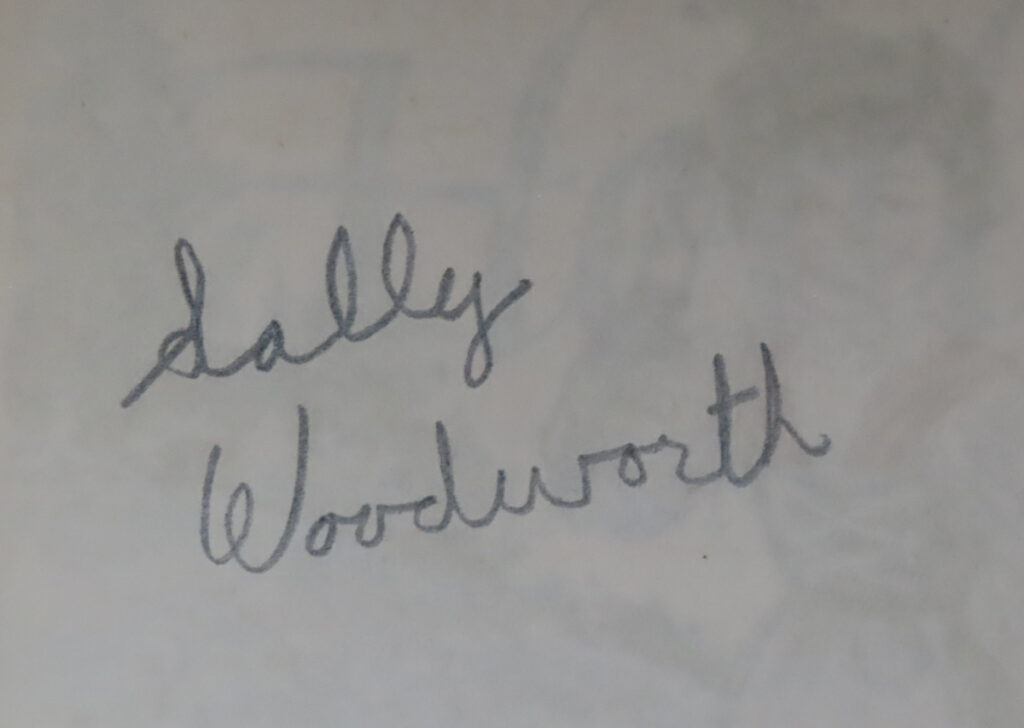
And here’s how I signed my copy of Heidi.
The second bloom in the garden of my reading life soon followed: going to the library by myself. On my prized blue Schwinn, I pedaled down Central Hill, turned left onto Woodland Road, then right onto Auburn Street. Once there, I’d choose the allowed four books, pedal back home, read those four, and next day, do it all over again. In the words of E.B. White’s Templeton the rat in Charlotte’s Web. “Oh, it was rich, my friends, rich! Such feasting!”
I can still sketch the layout of the children’s room; I remember where the series Childhood Stories of Great Americans was located, each one in a red cloth binding. From the shelf for encyclopedias, I took full (and heavy) advantage of the library’s circulating copies of old volumes, usually The World Book; shelved close by were the Landmark Books. I also knew where to find the Freddy the Pig books that were so funny. Eventually I’d present myself and my pile at the librarian’s desk, and watch as she used that intriguing pencil with the date stamp contraption clamped onto it.
There was, though, the puzzling fact that the library didn’t have Nancy Drew books; the librarian’s vague explanation made little sense. I read them anyway, borrowing from a friend whose Fairy Godmother aunt had given her “All the Nancy Drews!”
I also remember the adult rooms on the floor above, where my mother would try to choose my grandmother what Grammie described as “A nice book from the library.” Many years later, I realized that I’d mentally located a favorite scene from Little Women in one of the bays of the main room there.
Then, one afternoon, I came home from school and on the front porch, found three big cartons. I pulled one open, and—The World Book! Volume after volume, bound in red, with blue and gold trim. The cartons, though, were so heavy, I couldn’t lift them, so I plumped down on the doorstep, ripped one open, and pulled out the A volume. . . A . . . Animals, all those pictures, in color! Alcott, Lousia May. Airplanes, Alligators. America. Lots of maps. B: bats, bird, Boston, buffalo. . . I was still out there on the steps when my father arrived home from work a couple of hours later.
But The World Book came with conditions. Up to then, I’d always asked my father whatever I wanted to know; now the answer was always, “Look it up, Sal!” Often followed by, “Use the gray matter.”
After initial surprise, I didn’t resent this; I was having too much fun. Sometimes I read specific articles, other times I’d skim through to see what I’d find. The World Book lived up to its name. It also taught me to appreciate alphabetical order. One day I was to work on a joint oral report about the Panama Canal. To my mother’s and my amazement, my classmate David arrived at our door lugging all ten volumes of his own encyclopedia, which was arranged by order of broad subject areas. So I pulled out the P volume of The World Book and we took off from there. (I hope now that I wasn’t too smug.)
One evening probably a few months later, Daddy took me with him to the Central Library in Newton. I was just getting used to being the only child in that hushed reference room, when he said, “Let’s go up to the stacks, Sal!” We climbed to an upper floor and went into a room a phalanx of bookcases. No pictures or little chairs or windows, just shelves and shelves of dark-looking books, and a few grownups hunched over books in their hands, frowning, muttering to themselves. And my father doing the same thing.
All those books. All that information, just waiting for anyone who wanted it. Daddy was showing me the fascination of finding things out. The freedom to learn more. This gave yet another meaning to that poem Grammie had read: “The world is so full of a number of things.” Oh, that underlying optimism: whatever you wanted to know was out there, you just had to search and you’d find it—and it would feel good to know. Oh, and you might find all sorts of interesting stuff as you went along. (For one of the pitfalls of alphabetical order for me, has always been what’s on either side of the author or topic I’m after; I especially love the
juxtaposition of lives in a good biography section.)
By this time, in fourth and fifth grade, I always had my nose in a book. So much so, that my fifth grade teacher noted on my report card, “Sally sometimes neglects assigned work in her eagerness to do leisure reading.” And being read to hadn’t ceased either—only now the reader was my father, sharing Kipling’s Jungle Book. This seemed quite natural to me, as Daddy had served in India, during WWII. The carved elephant bookends on his desk came from there and he still used words and terms he’d used in Calcutta. A complicated, improvised way to tie stuff together was a “lash up” and a word supposedly meaning “Let’s get going, get out of here” was garadereer!
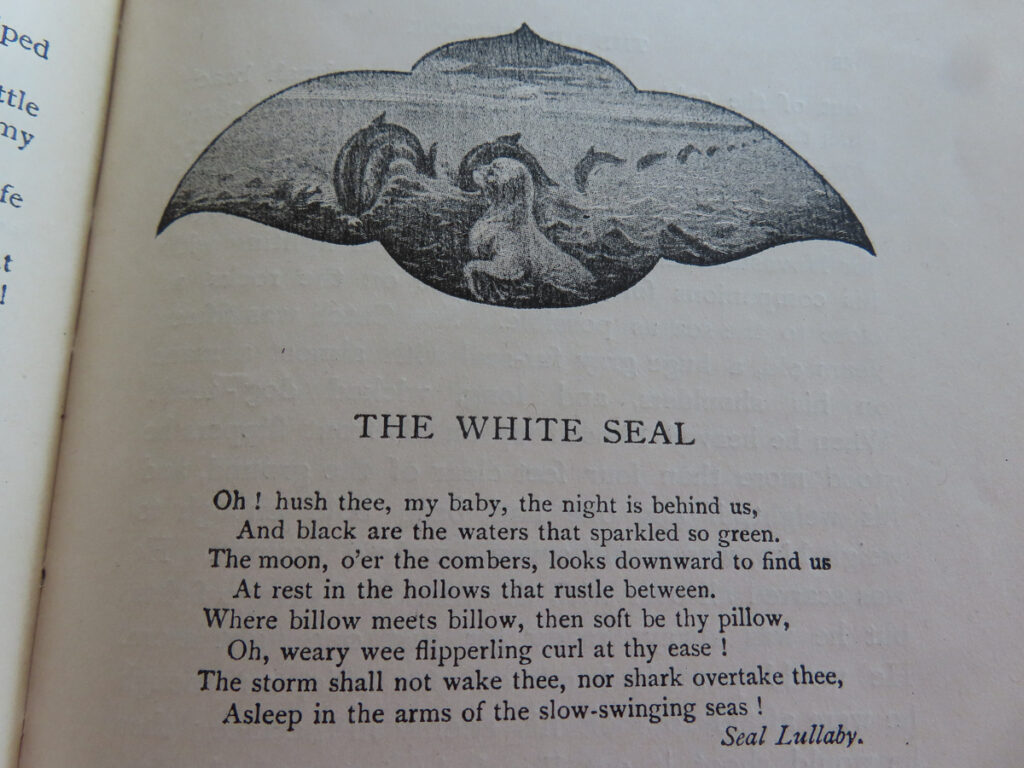
Daddy loved Kipling; I’m sure he’d been read The Jungle Book as a child. Now it was my turn. I barely remember the stories now but the poetry! The White Seal’s Lullaby. The sensuous rhythm and alliteration of “Oh! Hush thee, my baby, the night is behind us/And black are the waters that sparkled so green, . . . The storm shall not wake, nor shark overtake thee,/Asleep in the arms of the slow-swinging seas.” Again I was hearing not only the sound of wonderful language, but also a voice conveying security and love.
And then there was The Road Song of the Bandarlog! That “in your face” spirit of the monkeys! How could I not respond? “Dreaming of deeds that we mean to do/All complete, in a minute or two—/Something noble and wise and good, /Done by merely wishing we could./We’ve forgotten, but—never mind, /Brother, thy tail hangs down behind!” Daddy and I adored that last line.
Oh, and the last verse: “Then join our leaping lines that scumfish through the pines . . .Be sure, be sure, we’re going to do some splendid things!” “’Scumfish’ through the pines?” What a great word! I wished I could do that. And surely I, too, would manage some “splendid” things.
It would be in an another book house, however, for my parents were about to do something quite splendid themselves. I knew from dinner table talk that Daddy was getting burned up with his job situation at General Electric and early in 1957, he quit. Instead of “merely wishing he could,” he and my mother invested in a cottage rental business on Cape Cod; we would move there at the end of my school year.
We’d vacationed on the Cape for years and I’d always loved it, but . . .wow! Did real people actually live on Cape Cod? I was excited and happy, though probably about as realistic as Kipling’s monkeys; my parents, especially my mother, knew they were really taking something on.
Once again, a book came into play. This time in the living room after supper, while my mother knitted on the couch, Daddy read from across the room, the light shining on his broad forehead and reflecting off his glasses. I can’t remember if Grammie listened or not.
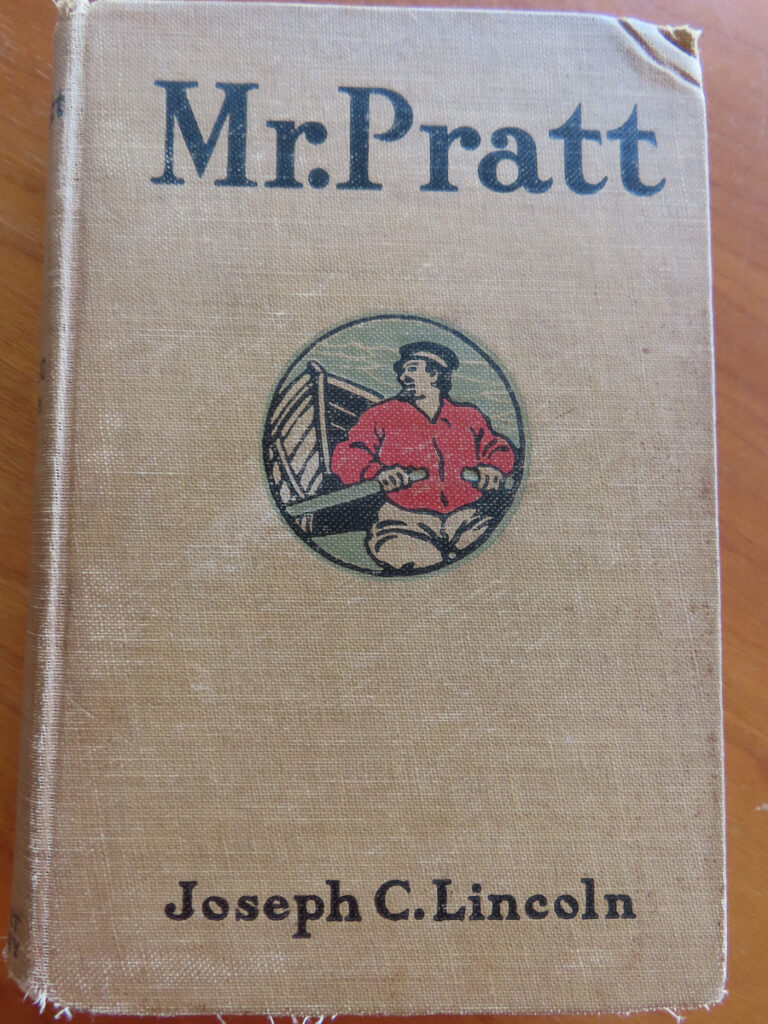
He chose a 1906 novel about the Cape, Mr. Pratt by Joseph Lincoln. A popular author right up into the 1940s, Lincoln provided a funny, often corny introduction to the “summer people vs. sage old Yankee” life we were about to enter. Every chapter was funny and often ended on a cliff-hanger. I’d beg for one more, only to find myself just as tantalized. Antiquated though Mr. Pratt was even then, I loved it, and I think my mother did, too. Were there really old codgers and daffy summer visitors like that in real life? The answer was mixed, we were to find.
My parents talked up the property they were buying, telling me we’d have lots of land with pine trees and our own pond to swim in. Whether they or I made the connection at the time, from my very first day there, I did my own version of “scumfishing” through those pines, with our dog Buster as the stand-in for the monkeys whose “tail hangs down behind.”
I was already aware that all three adults I lived with had lived in other places: my father born in California, my grandmother who still corresponded devotedly with her family in England; in addition, my mother and father had both served in the Navy during “the war.” They all kept referring back to those times and places. Now 366 Central Street would become “where I was from.”
Once moved to Cape Cod (I was eleven) I plunged into that life, and rode my bike to
another library. Having served as a bridgeMr. Pratt, led us forward; ever since books have acted as a transferable home of and for my mind in new places.
But always I harken back to Central Street. The secure and happy nest where I became a reader. And happily I celebrate all these decades of delight in books. In loving to read.