
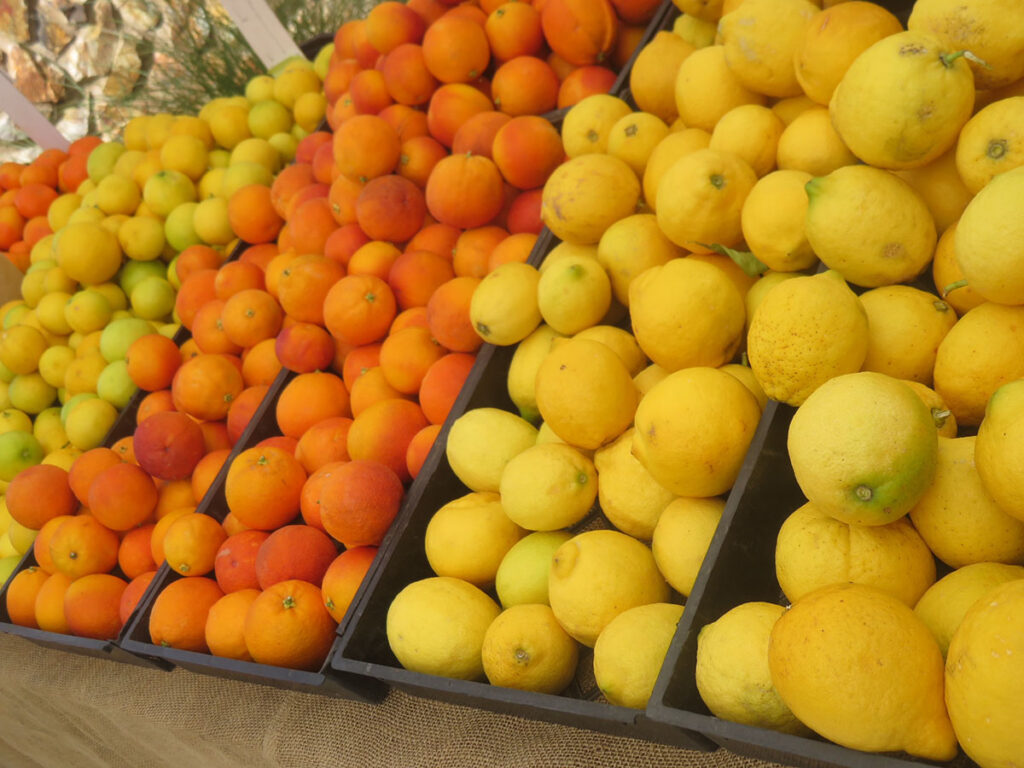
The Farmer’s Market on a recent Saturday afternoon, and I’m gazing at the bounty of early January in southern California. What to buy? Which lovely opportunities shall I select from the glowing spectrum before me? Orange, yellow, green, even the rosy blush of blood oranges.
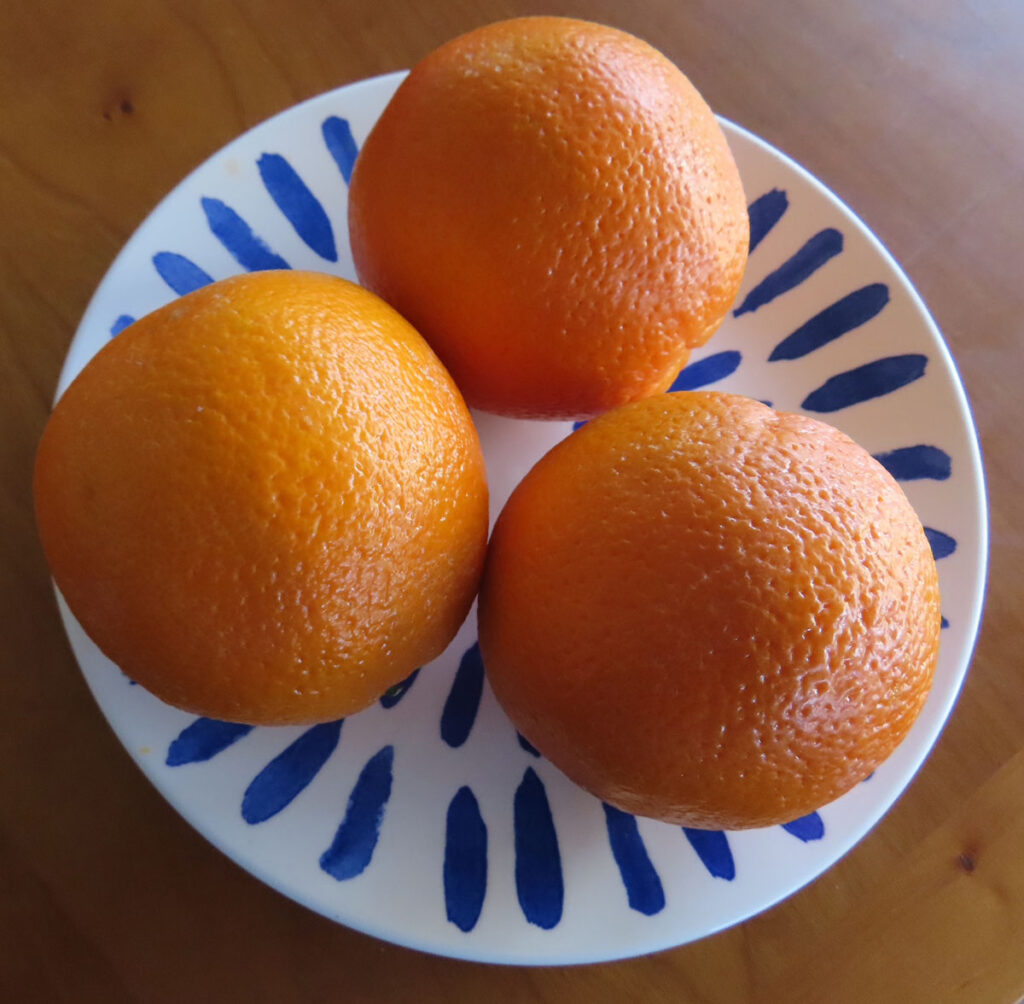
Then my eyes fall on a carton of perfectly round, saturated-orange spheres: cara cara oranges. Oh, that romantic-sounding name! And in that instant, I imagine some smooth tenor voice entreating me, “Cara, come to me! Cara, darling, let me caress you!”
Of course that’s what I’ll buy! Once home, I contemplate the cara caras setting them out on a white oblong platter, interspersed with lemons. I want to make something very special so am willing to take more time and care than usual. Soon I decide to make a cake.
But not just any cake. I consult my New York Times Cooking app, using “orange cakes” as my search term. I want something where both the juice and zest of the cara caras aren’t just incidental, but vital. A deeply flavorful cake. Finally I select Julia Moskin’s “Juicy Orange Cake.”
Curious about the cara caras’ seductive name, I’m surprised to find that its origin was something of a fluke; it was an unexpected hybrid discovered in the state of Washington, and later named for an hacienda in Venezuela where they were also found.
Who would share the bounty with us? Our friend Jim, for whom I especially like to cook, is coming for dinner. He lives alone and doesn’t cook much, so I always send something home with him and of course a cake easily fits with this plan. Though my main dish, chicken cacciatore, also comes out beautifully, for me, the Orange Cake is the dinner, of course starring the Cara Caras.
Early in the afternoon, I go to work. Steaming around my kitchen. Of course I’ve made many cakes over the years and know the basic principles: pre-heat the oven, prepare the pan, assemble your ingredients before you start the assembly process, keep the recipe right at hand—and read carefully. I catch myself muttering “baking powder” when it calls for “baking soda” and quickly correct. (No, I don’t even get as far as measuring the wrong one.)
However, now I do anything but caress those oranges. I rasp their flesh with my micro-plane zester, then cut them in half and squeeze all their juice. The zest is extravagantly orange-colored! And another extravagance: this recipe is profligate with butter. Two sticks, half a pound! Seldom do I use so much at a time, but I know it will carry the flavor especially well.
My hands are happy now, using old favorite utensils. I dig out a favorite spoon from the dishwasher, a good strong spoon whose handle doesn’t give when the batter thickens. Then there’s my old red rubber spatula, also the measuring cups I’ve used for decades. Old friends. I love to manipulate food with them, to feel in charge via hands and fingers. I play the batter through its stages: first thick and floury, then clumpy, and ultimately smooth and loopy and pliable.
But then. As though sending the batter into space via a capsule, or what might be seen as a dark prison, I consign it to the oven. Only when the cake times close to being done, do I get back in touch via tester; finally I tap the top lightly with my index finger to make sure it springs back as it should.
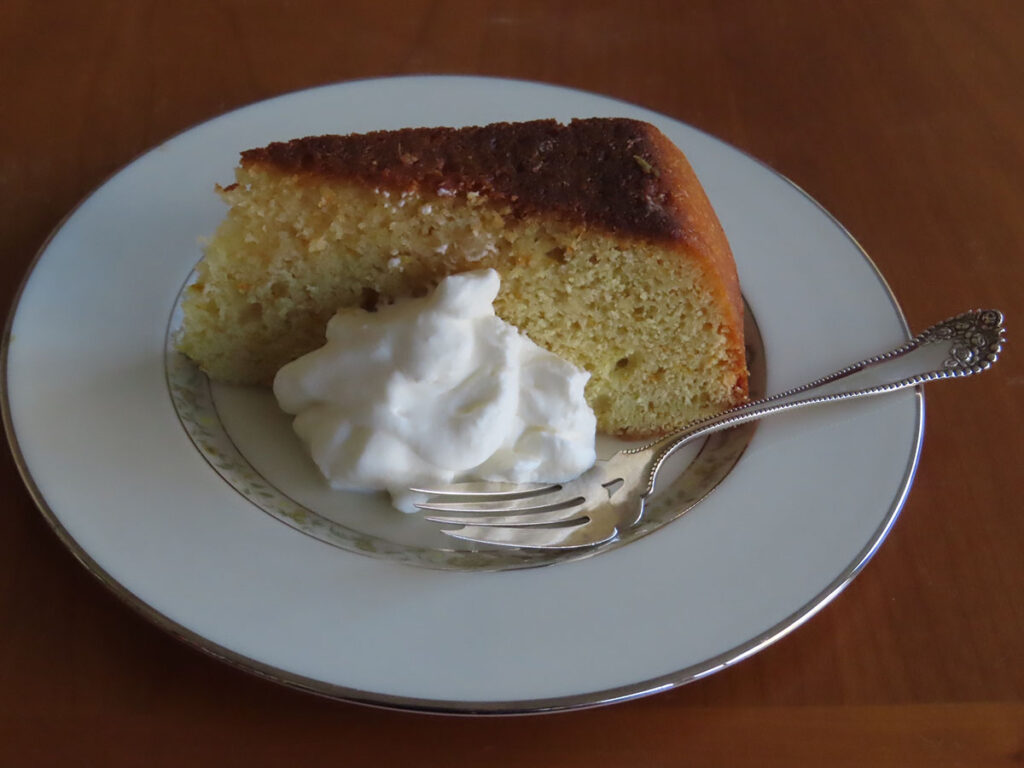
So how does my cake come out? Due to using parchment paper, as suggested (I’m not very familiar with it), the cake is a little misshapen, not a perfect round. It’s also a little dark on top. No, not burnt, but perhaps on the verge.
But that orange flavor! It’s so good, I don’t care.
I serve the slices along with whipped cream tinged with Cointreau, thus a triple orange treat! This cake is substantial yet somehow not heavy and as I’d hoped, redolent of these cara cara oranges. In fact it’s so good, I can’t resist a second slice. There’s nothing like your own cooking, is there, Sally? And when I offer Jim some to take home, I think he was hoping I’d say that. I send him off with a quarter of the cake.
Eleven o’clock that evening, just before going to bed, I turn off the light in the kitchen. But not before casting a last loving look at the orange cake. And lifting the plastic wrap, I cut a sliver about an inch square, and—oh, yes, taste it once more. Oh, yum!
Sometimes when I’ve tried a new recipe, I’ll think, Oh, that was OK, but it isn’t worth the trouble. All that work, not enough reward. Not so, this time! I will make this cake again, for sure, though not casually. The cake is large, also very rich and requires all that butter, also buttermilk, something I seldom use—and now must figure out a way to use up.
Next morning, about six, I lie in bed, thinking How lovely it is to make a cake. I’ve accomplished something, created a new thing. Pretty self-indulgent, Sally! Let’s face it, you’re having your cake and eating it, too. And I seem to hear a distant guitar, some sensual chords strumming. . . and a buttery tenor crooning, “Que exquisito, senora! Buen gusto, molto delicioso!”
We love Cara Cara oranges but usually just for eating. Now I must make this cake! It looks absolutely delicious! You have written beautifully about baking and have spoken directly to my love of planning and cooking and baking a good meal. And our photos of the oranges and the produce at the market are fabulous. Colorful and zesty!
Probably not on the Mediterranean diet plan though.
Valerie
Hi, Valerie- Thank you so much! And by the way, I’m finding that the cake keeps very well – I’ve kept it in a sealed container in the fridge, and tested it yesterday– still good! But alas, the diet plan . . . that’s a problem I can’t solve, I think! Sally
Fun read, Sally, I can almost taste it!
Thank you so much, Meridith! Sally
Now that’s funny, do you know that a Cara cara is also a kind of vulture? A rather striking one, but still, that’s what I thought you were talking about from the title, and it caught me a bit off-guard when it turned out it was an orange … even though I have a cara cara tree in my back yard. I don’t suppose you’d want to share the recipe? I could trade you for Steve’s southern biscuit recipe that would use more buttermilk! PS, I know what you mean about the utensils you’ve used for years. I especially enjoy using my mother’s teaspoon measures, and my grandmother’s brownie pan.
Hi, Janet — I think I’d known about the vulture by that name, but the orange certainly comes first to my mind. The recipe is from the New York Times – if you don’t subscribe to that, I’ll get you a copy of my print-out. I’d love the southern biscuit recipe! Thanks for your interest! Sally
I’m very hungry now. It’s quite beautiful, and I can almost spell it, but not quite.
Wish I could share some with you right now, Kathy! Sally
Oh my! I should not have read right before dinner, late in the afternoon when I am already so hungry! How deliciously written! Can’t go wrong with half a pound of butter and ambrosia! Lucky Jim and Andy!
I’ll make it for you sometime — it would be a pleasure! Sally
What a delightful treat to read this, Sally! My mouth was watering as I read. Wonderful photos to accentuate to story. I enjoyed your vivid enthusiasm – your zest!
Looking forward to being in contact soon. Shall we Zoom?
I’m living in a senior housing community in Rohnert Park (next to Santa Rosa) now.
It’s working out. Can’t remember if I’d mentioned that to you. Been here a few months now.
Laurie
Laurie, Thank you so much! Yes, I’d like to get back in contact, too — we need to catch up. I knew you had moved, and I hope things are going well. I’ll be in touch! Sally
First, what an amazing joy to find a variety of citrus at a farmer’s market in February. Second, I hope someday to enjoy a slice of your orange cake sitting with you in the California sunshine. Triple pleasure! Love, Marlene
I’d sure love to share this with you, Marlene — let’s hold the thought. Our last meeting was all too brief, too! Sally
PS, just kidding about the recipe; you deserve to save this one for yourself. HOwever, if you do want the southern biscuit recipe, just let me know.
lovely
Thank you so much, Beth! Sally