
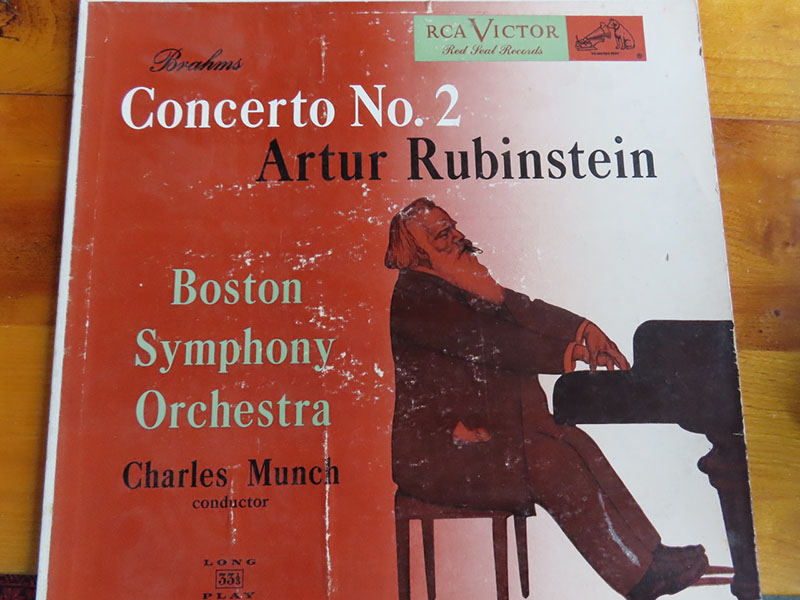
I grew up with two fathers: one, my biological father and the other, Joannes Brahms, the composer whose music Daddy and I most loved. At times the two blend together in my mind, for whenever I hear the music of Brahms, I’m folded into a wordless embrace of intimacy and memory.
This relationship evolved because Daddy and I listened together in my teen years, but it was also made possible by a commercial product: long playing records, known as LP’s, or 33’s for their number of revolutions per minute.
LP’s first became available in 1948, around the time my parents (really my father) bought a Magnavox console record player. Their marriage was then three years old and I was just two, so LP’s and I grew up together. As a kid and a teenager, I thought of them as close to magic. The greatest present I ever received was my first LP—Sousa marches—when I was ten years old. I remember the wrapped package, impossible to disguise, under the Christmas tree with my name on the tag. I felt like I was a grownup now.
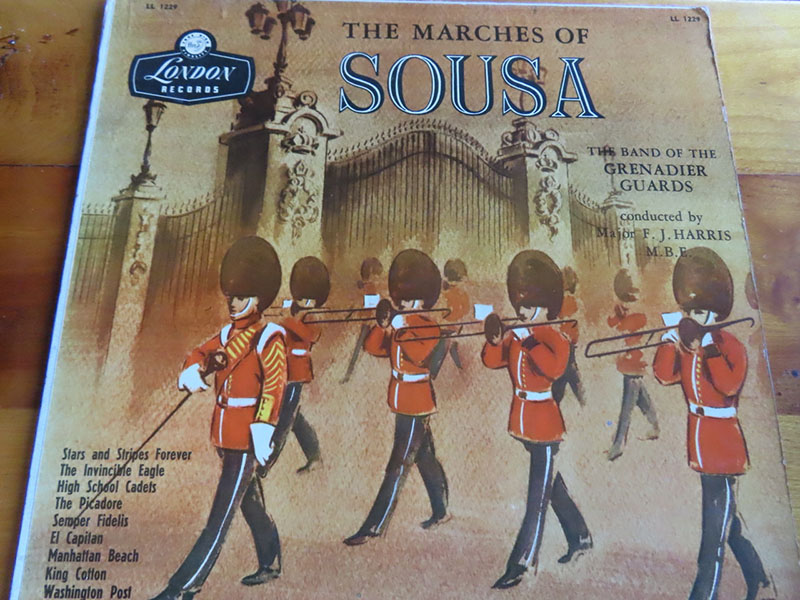
What was so magical? Daddy said it one evening when he stood for a moment with an LP in his hands. “Think of it, Sal! All this music on this one piece of plastic!” Now a whole symphony or concerto could fit on one record instead of the stacks of 78’s we still suffered through occasionally. I hated their loud changes every five minutes or so, an event somewhere between a crash and a plop, which kept disrupting any spell the music might cast.
And, this new miracle came in a distinctive package: a “sleeve” or jacket, a cardboard envelope 12” on a side. It was like holding a square foot of music. Just what music was identified by tiny print on the spine and lettering and/or illustrations on the front of the album. Besides certain images which I still connect with specific pieces, those pictures often stirred me to visualizing music as well as listening. And the liner notes on the reverse side taught me much about what I was hearing.
I’m far from the only person who revered those records; I’ve seen 12” square picture frames designed to display those old LP jackets and can easily imagine a wall of family portraits with an album framed right next to my father’s portrait. That would be RCA Victor LM 1728, Brahms’ Piano Concerto No. 2 played by the Boston Symphony with Arthur Rubinstein as piano soloist, Daddy’s and my all-time favorite.
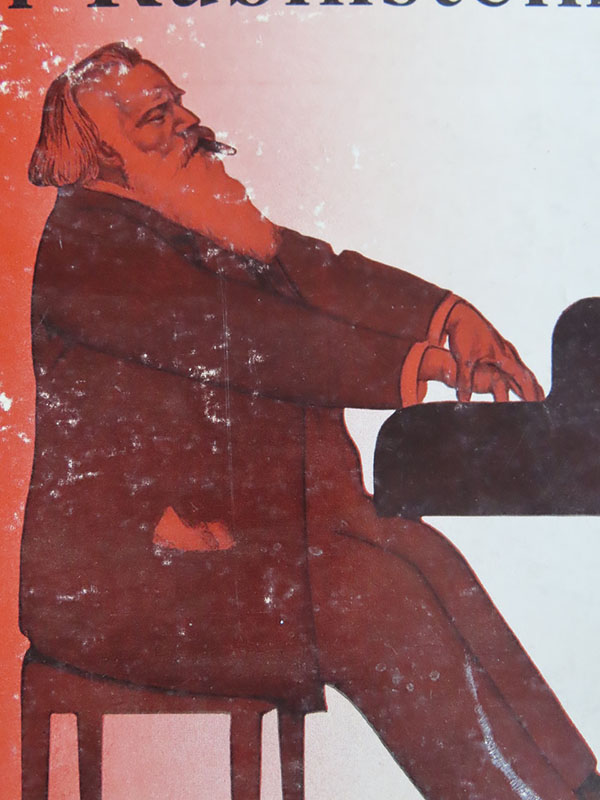
The jacket offers a famous portrait of Brahms by Willy von Beckerath. Shown playing the piano with his left hand crossed over his right, Brahms’ eyes are closed and a white Santa beard covers his upper chest. The picture gives the impression that he’ll play on and on, contemplating the music, presumably his own.
Like other great composers, Brahms was a man of many moods; I used to wonder how his music expressed enough emotions for two people, and how he could speak in such contrasting voices. Often it flows smoothly and emotively, the way the man in the portrait seems to be playing; another of his voices is loud, jagged, and strident, the way his first and third symphonies begin. They’re like soundtracks for invading armies. Those slashing arpeggios that start off the third symphony make me want to cry out, “Oh, no!” But when those sections play themselves out or transform into singing melodies, here’s Brahms as his intimate self again. Not for long, though! Now he sets the strings scrubbing around again, like a garrulous relative insisting, “You’ve got to hear this!” Eventually Brahms relaxes, though, and it’s as if we sit down for a glass of wine and he quotes poetry or tells charming old stories. “Oh, do you know this one, Sally? This is my favorite. And have you heard this?”
Changes, shifting moods. They’re part of Brahms and of my father. At times, Brahms captures Daddy so neatly that he’s practically conjured up in a hologram like a character in Star Wars. At certain moments in the slow movement of the Piano Concert No. 1, I expect to see Daddy walk in, plump down in his lumpy old green chair, put a Pall Mall in his cigarette holder and take over from the music, saying, “You know, Sal . .” I hear his earnest manner and inquiring turn of mind in the upward curving melodies. The notes venture out in sequential phrases much as Daddy offered ideas, often in the form of questions, and let me draw my own conclusions. He spoke from the heart yet I wasn’t required to agree or feel a certain way.
I still nod with rhythms as my father did, and find my right hand fingers tapping the “long-short” rhythms on my knee at a favorite passage in the Piano Concerto No. 2, the part I always think of as a flowing river, also with the stream of rippling sixteenth note arpeggios that soon follow. Often I’d look over and find him doing the same thing.
Another place I meet my father, this time in Brahms’ Symphony No. 2. A gracious melody first played by low strings, it’s cast in the range of Daddy’s speaking voice. Plus the melody captures the way he sounded when he talked with someone he really liked. As if representing me, his flutist daughter, woodwinds answer with flutes on the top octave. Little musical comments are interwoven, instrumental “um-hmmns” or “I see what you mean’s.” Down beneath, the double basses pluck pairs of notes like heartbeats and as I listen, I feel carried by some great being who walks with a surprisingly light step.
But what about Brahms’ bombast? Well, my father had his dark side, too. Although he suppressed open verbal anger, his grouchy, silent moods spoke for him. Not only was Daddy less than successful financially, he was also a creative individual who would have liked to operate independently but possessed no fully developed talent or business acumen to make this viable. He told me once, “You know, Sal, the one thing I’ve never figured out is, how you get paid for doing what you want to do.” I think Brahms’ strident or inexorable loud sections embodied the pressures Daddy felt but made them seem manageable because the music carried him so powerfully to triumphant resolution.After an evening of LP’s, perhaps he felt he had faced down the pressures, or at least put them aside.
One Christmas, my mother bought him an LP of Brahms’ Symphony No. 1. She showed me the album in the local record store and sighed. “I wish this piece weren’t so loud and pounding . . . but I know Bill would like it.” She herself didn’t particularly like Brahms and greatly preferred Chopin and light, short pieces; some evenings she retreated to the bedroom to read when we listened.
As soon as Daddy put on the new record, I realized how generous she’d been. With the first notes, that symphony’s grinding harmony wraps itself around my head and squeezes. Yet it also has its tender moments, and some noble ones, too. I heard them back then and I hear them now, melodies that almost melt me. But not for long! Like someone wary of deep intimacy, as Brahms himself was, the music soon shifts back to loud tilting at windmills. The orchestra thumps along. Sometimes the thumping ends a section or movement, or once again another mood descends—and the melody will convey such peace that I feel blessed and deeply loved. And in the finale, I’m lifted up and carried to victory.
I do remember wishing, though, that Brahms didn’t always cut lyrical sections off so soon. Some nights I’d retreat into a book during the big heavies, listening with half an ear for the parts I really loved. Sometimes now Brahms’ “heavies” seem even heavier to me and I find myself thinking, “Oh, come on, Johannes, give it up! That’s enough.”
Then I turn to Brahms’ chamber and piano music, where his moods don’t roll over me with such force. Here I meet the person in the drawing, a man thinking out loud at the piano, musing to himself. When Brahms wrote these pieces down, he created small worlds in just a few pages. My father didn’t know this music—he would have loved it —but I find him there, too.
Recently, when I was in the hospital last June, I hated the long nights. While my illness was not life-threatening and I made progress every day, still those evening hours stretched out and I felt extremely alone. Yet again with thanks to technology—and Brahms—I took to lying in the dark playing beloved music on my cell phone, and on one such night, Op. 118 No. 2 calmed both my body and soul. I was alone no longer. I followed it with Brahms’ Opus 117 No.3 and the little groups of notes, like suggestions, reminded me of Daddy’s expression when he’d look up from a book to tell me what he’d found or to chew over an idea. The hovering, questioning phrases summoned up memories from the shadows of my mind, answered them, and I was calm again.
All these years later (my father died in 1979), I still feel him with me, listening, watching over me. The music of Brahms is our common ground, our Island of LP. Whenever I go there, I’m home again.
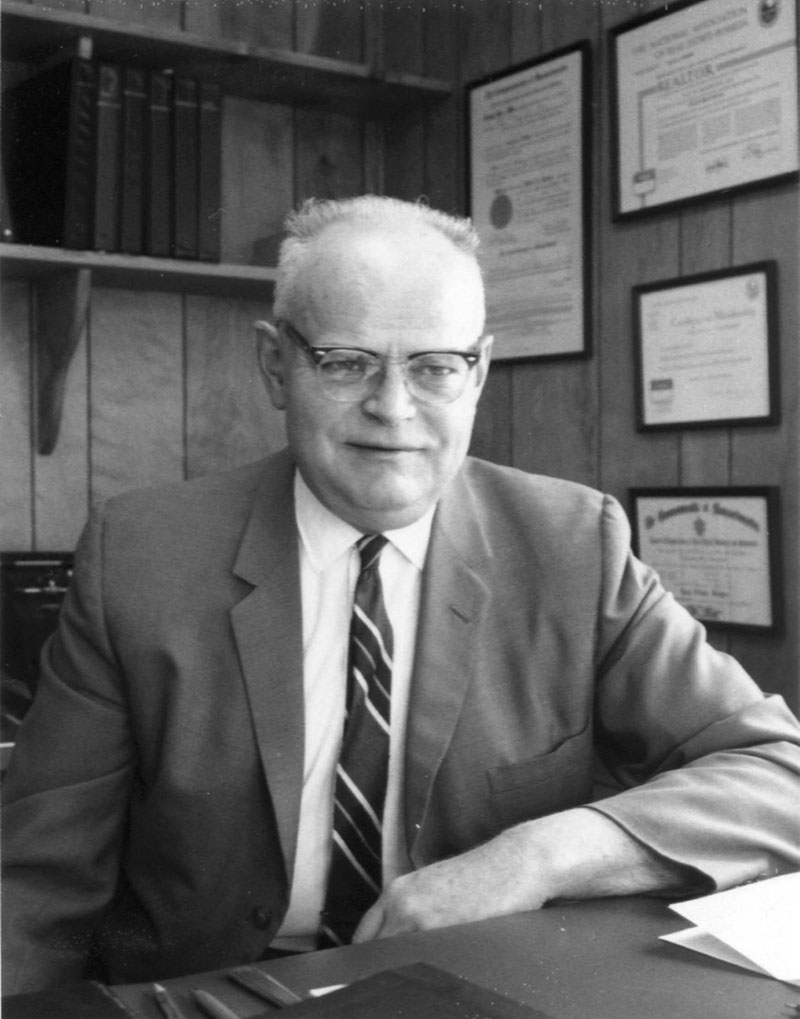
Sally this is magnificent!! I too listened to music with my father, although he was much more eclectic, with Rachmaninoff, Prokofiev, Brahms, Chopin, Duke Ellington, Django Rinehart, Dvorak and more, but being exposed to music, especially classical music, is wonderful for a child. And the relationship that you shared with your father through the music really shaped you life, wouldn’t you say? Playing the flute and being immersed in symphony music all those years. Not to mention marrying a musician! I’m just so happy that you shared this beautiful piece with us, your friends. Thank you!
And P.S. My husband Jim loved his John Phillip Sousa records and listened to them all the time as a child. He still loves band music!
Oh, Sally,
I loved this evocative contemplation of your father and Brahms! Thank you so much for sharing! Music & LPs one-on-one… I hope that we will meet up one-on-one this coming year and raise our glasses to memories of music & the Eastham of our childhood.
Love,
Marca
My dad and I would sit and listen to all kinds of music together. I had forgotten about them. Can’t remember the specifics now, but mostly classical and old tunes from his day. I of course rocked out to Elvis and all the 50’s music by myself!